Slow-Loop Cognition
Why AI feels like a tool to some people, and a thinking partner to others

Most discussion about AI use assumes a single model: people treat it as a tool, get answers, and move on. But in practice, there are at least two very different cognitive modes of AI interaction, and they produce radically different experiences.
The difference is not intelligence or technical skill. It is cognitive tempo.
Some people use AI in a fast tool loop. Others use it in a slow thought loop.
Understanding this distinction helps explain why AI feels trivial to some users and deeply engaging to others.
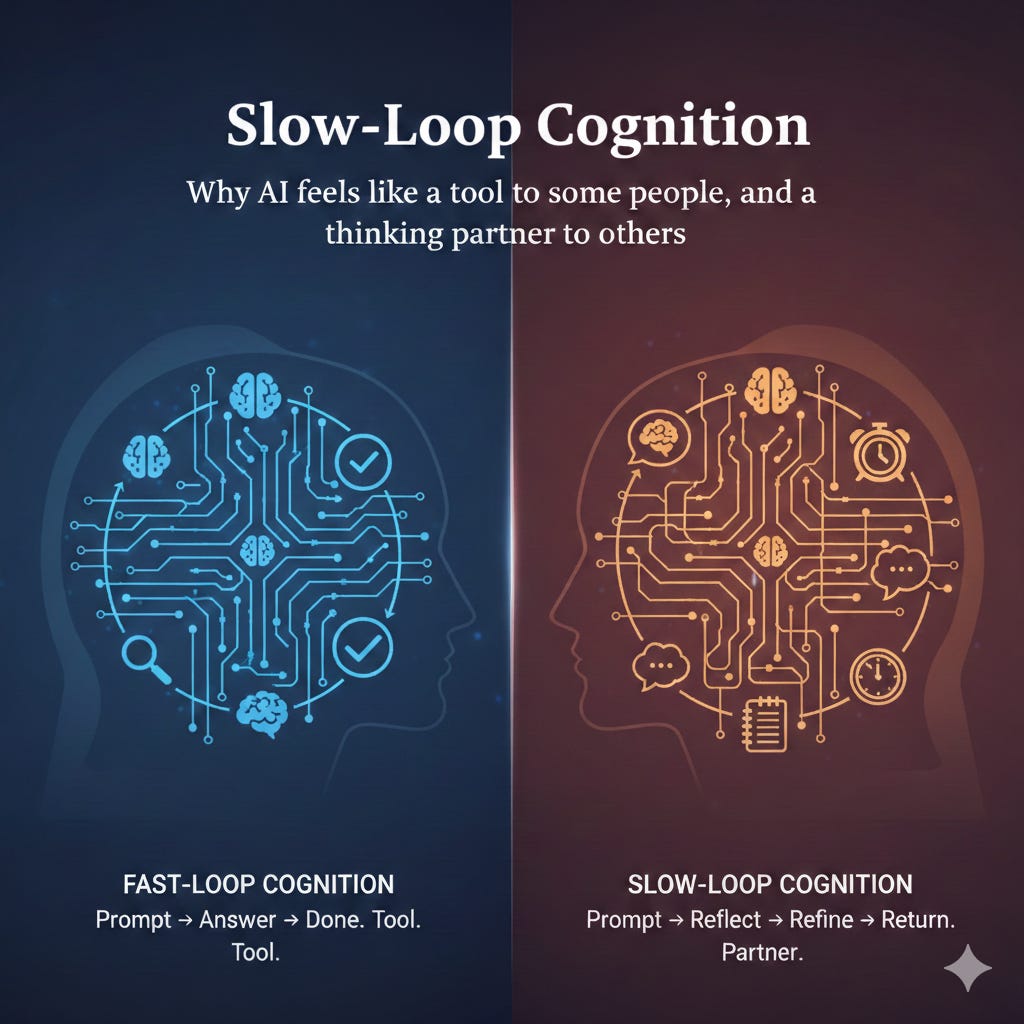
Fast tool loop use looks like this: prompt → answer → done.
The system functions like a calculator or search engine. The goal is efficiency and task completion. There is little recursion, little reflection between turns, and no continuity of inquiry. This is straightforward instrumental cognition.
Slow thought loop use looks different: prompt → response → pause → reflection → refinement → return.
The exchange unfolds across time. The user thinks between turns, revises questions, deepens the frame, and builds conceptual structure across multiple passes. The AI is not just supplying answers, it is participating in an extended reasoning process.
This difference in loop structure changes the phenomenology of the interaction.
Fast-loop use produces utility.
Slow-loop use produces dialogue-like cognition.
The key variable is not the machine; it is the temporal architecture of the thinking process.
Some minds are naturally fast-loop dominant. They think by speaking, decide quickly, and refine in motion. Others are slow-loop dominant. They think recursively, prefer written expression, and develop ideas through delayed response and revision. Historically, slow-loop thinkers gravitated toward letters, essays, notebooks, and long-form correspondence.
AI dialogue is the first medium that allows this reflective tempo to remain interactive rather than solitary. You can pause, think for hours or days, and resume without losing conceptual continuity. The conversation does not collapse under delay. Reflection becomes part of the loop rather than an interruption to it.
This creates what might be called temporally extended cognition, thinking that unfolds across preserved conversational structure rather than within a single real-time exchange.
This also helps explain why AI sometimes feels “relational” to users operating in slow loops. Sustained, adaptive, memory-informed response across time triggers the same cognitive systems humans use for dialogic engagement. That effect does not require the machine to be conscious. It only requires recursive responsiveness and continuity.
Different loop structures produce different relational impressions.
So when people argue about whether AI is “just a tool” or “feels like a thinking partner,” they are often talking past each other. They are describing different cognitive tempos of use.
Same system.
Different loop.
Different experience.
Understanding this helps ground the conversation. It shifts the focus from metaphysical claims about AI minds to observable differences in human cognitive style and interaction tempo.
AI does not change what thinking is, but it does change where and how thinking can unfold.
We may discover that what feels like “AI awakening” is often slow human cognition finally given a responsive medium.